
Taste as discipline

The hand that knows what to remove is worth more than the hand that knows only to add.
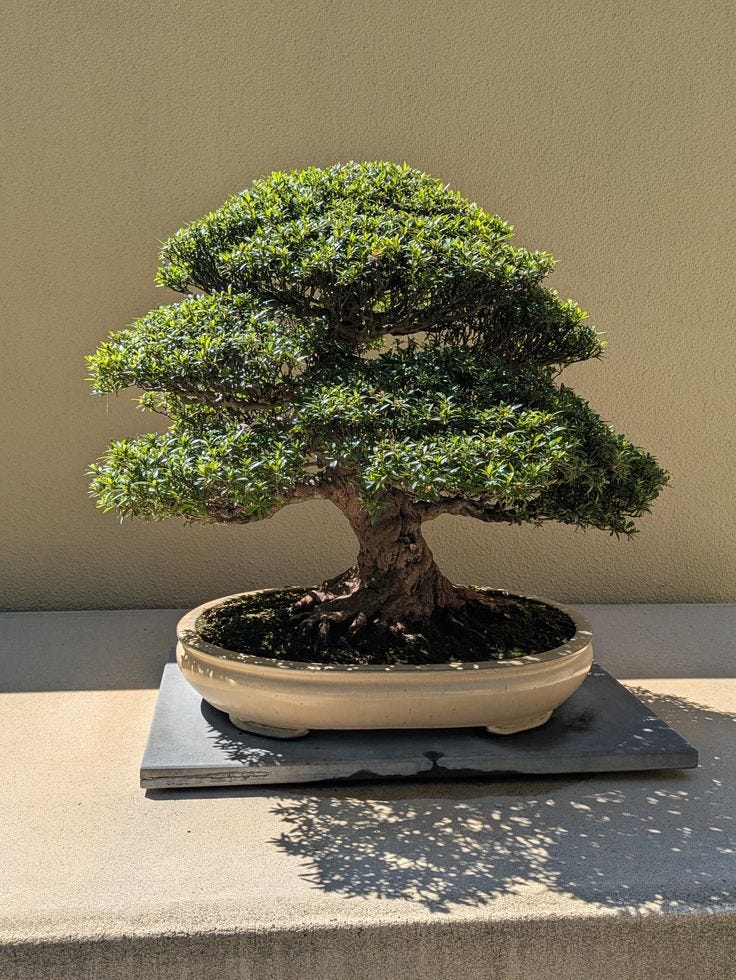
Just ask a bonsai-shi.
The Japanese bonsai master whose lineage has kept one small Japanese white pine alive for 400 years. His teacher trained him, who was trained by his, who was trained by Mr. Miyagi and thus the lineage flourished.
And their entire job is not planting, not feeding, not watering, not any “normal” gardening task.
Their entire job is to cut.
And they cut what’s healthy.
They cut the perfectly good part of the bonsai growing in a perfectly good direction because the master can see that in ten years it will thicken the silhouette and drag the whole bonsai toward mediocrity.
His job is not to merely keep the tree alive, no, even you or I could manage it. His job is to keep the tree beautiful. A beauty you only get through subtraction.
Anyone can add.
Any child can water and make a plant flourish.
It takes four hundred years of precise transmitted knowledge to know exactly what to kill.
This, of course, isn’t about bonsais.
It’s about you.
You are a bonsai.
Everything you’ve ever watched and read and scrolled — it all grew to be who you are.
Most people spend their lives on the easy side of self-care: adding, adding, adding.
More information, more content, more noise — a mind grown wild and shapeless because bigger is better right?
As we know, thanks to our friend the bonsai-shi, it’s not. Beauty is in found in subtraction.
It’s found by cutting with shears.
Shears that can be developed. Shears that we call taste.
Defining taste
“Taste is a collection of things you like.”
No. That’s shallow and easy and you aren’t here for that.
Taste is not a set of possessions you can show to others and the way to improve taste is not to go out and collect more and more objects.
Rick Rubin, goat of taste, is not a hoarder.
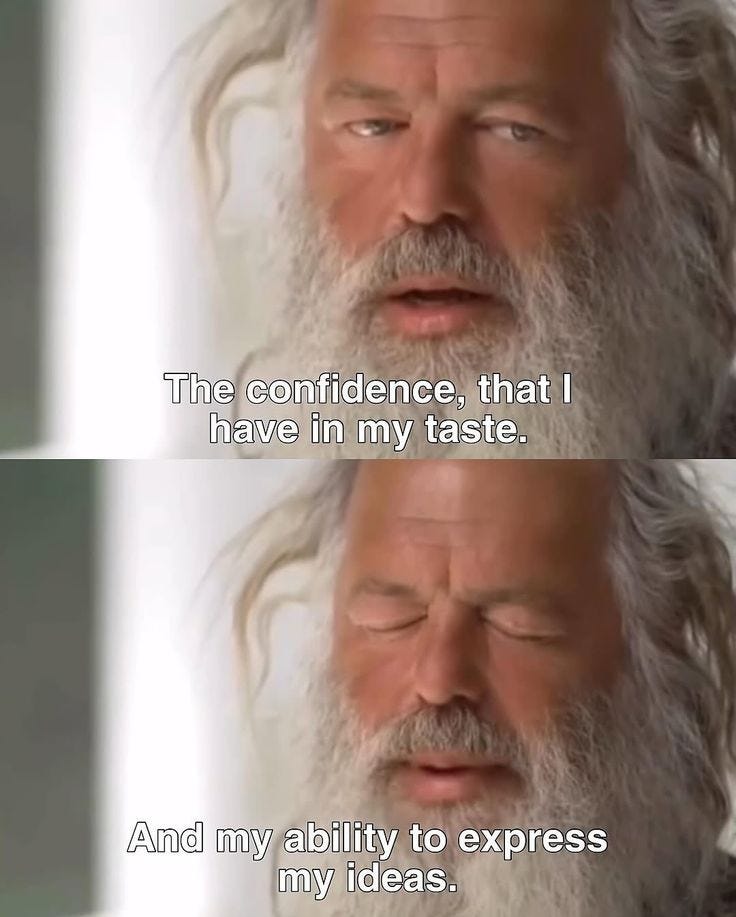
Taste is a by-product.
It’s what overfills from a full cup. A full cup being a life in which you engage with three simple habits:
remove the weeds of slop
put good work in front of yourself
do what you can’t until you learn you can
Do this for years and you develop an instinct, like the bonsai-shi.
This instinct is fine-tuned toward the beneficial — which is a setting much stranger and sharper than the “taste is what I like” goofy setting lots of people default to.
Your taste registers events, people, places, things, ideas, works of art, music, overall things and experiences that improve quality of life. When it’s genuinely novel, when it produces awe, when it evokes an involuntary wow, or when it produces some mind-boggling insight or idea you can apply to your life tomorrow.
Taste is a tool for self-improvement — a meter that detects is this making my life worse or better.

It defines what you read, who you spend Friday nights with, the thoughts you allow yourself to indulge in — taste defines standards of action and standards of thought.
The refinement of your taste is the refinement of your life because taste decides what your life is made of.
Let’s get to it shall we?
I. Pull the weeds
A weed, in this context of taste, is anything that saps your attention and returns nothing of substance.
It’s something specifically engineered to give you the sensation of a goal achieved without the effort — it’s instantaneous pleasure, available at all times, the greatest killer of taste.
Weeds fits nicely into 99% of short form content and 99% of the hyper-attention economy.
Removing this slop soul-sucking Mr. Beast content (yes because every hyper-edited WE JUST FILLED MY BROTHER’S ROOM WITH 1000 CONDOMS is absolutely frying your shit) has to come before anything else.

It’s the multiply-by-zero problem.
It does not matter how many great books you read a week or how many long-form interviews/podcasts you watch if you are still doom-scrolling and consuming the hyper-attention masturbation content.
If your equation of taste has that zero (big Mr. Beast) in it, everything else you try to add (all those books) still gets multiplied by that zero, leaving you with nothing, no development, no growth.
The negatives of shit content far outweigh the positives of good content.
Removing the zero is worth more than adding ten positives.
What I’ve come to realize with taste is that there is an uncomfortable period — very much like the one in any period of self-improvement in which you find yourself isolated from what once was but not developed enough to reach what could be — after you pull the weeds.
You keep reaching for that void, the pull back towards Mr. Teeth — the need for low-grade stimulation is something I used to feel all the time, I wanted something to entertain me when I ate or when I trained or when I felt like life wasn’t enough — and what fills this space is curiosity.
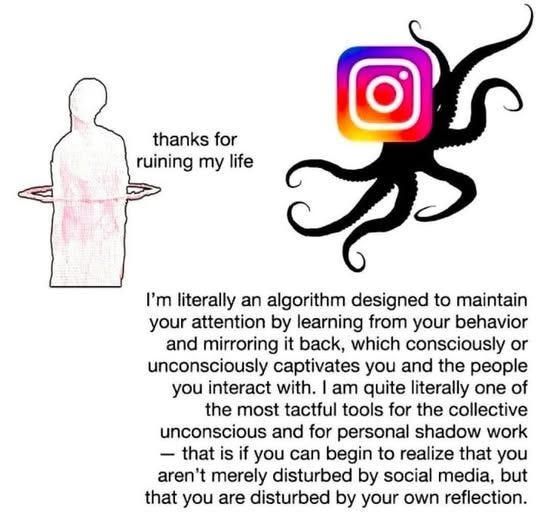
Trying new stuff, following what could be, being lead around by interests instead of the algorithm.
It’s a transitional mess — mostly because many people’s attention spans are fucked — and it takes longer than you’d like, but it’s necessary. You must remove the zeroes.
That’s our foundation.
II. Consume good work
At the start you have no idea what you like — only what you’ve been shown — so the job is experimentation.
Learn across everything — any little podcast or video or article or niche exploration on the history of balloon animals and serial killers you should look into. Then, when something grabs your balls harder than the rest, you follow that fucking rabbit hole all the way down and find the bottom, and then you keep digging until your curiosity on this certain topic is satisfied.
I, for one, have really been loving movie analysis content. I’ve always loved movies and learning from fellow cinema lovers who break down the intricacies of cinematography, dialogue, lighting, and the process behind the stories I love is so insanely interesting to me.
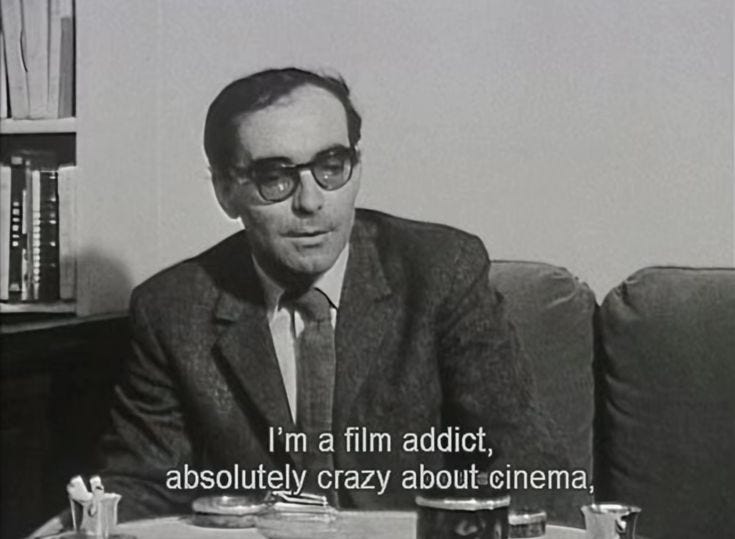
Never confine yourself to “your field” or “your interests.” There is always more to be learned, more stuff that you’ve never tried.
My interest in movies helps me understand story structure and character arcs, which I can use to improve my writing and make my articles more engaging.
Polymathy is the move, it always is.
If you ever get bored with music or science, you can dive into the cosmos or how equilibrium and unpredictability work with one another in sports. Nothing is ever too uninteresting to bring some light into your world.

Every discipline you go deep in installs a new filter, and the more filters you can see through, the more of any given thing you can see and the more solutions/angles you have to the problems you face.
By being able to dissect events and problems with 5, 10, 15 different perspectives from your different interests, you are able to see and act upon ideas that others, who never follow their curiosities, cannot see.
And thus create outcomes they deem inexplicable (which makes you irreplaceable).
Every discipline and idea that doesn’t seem to connect compound.
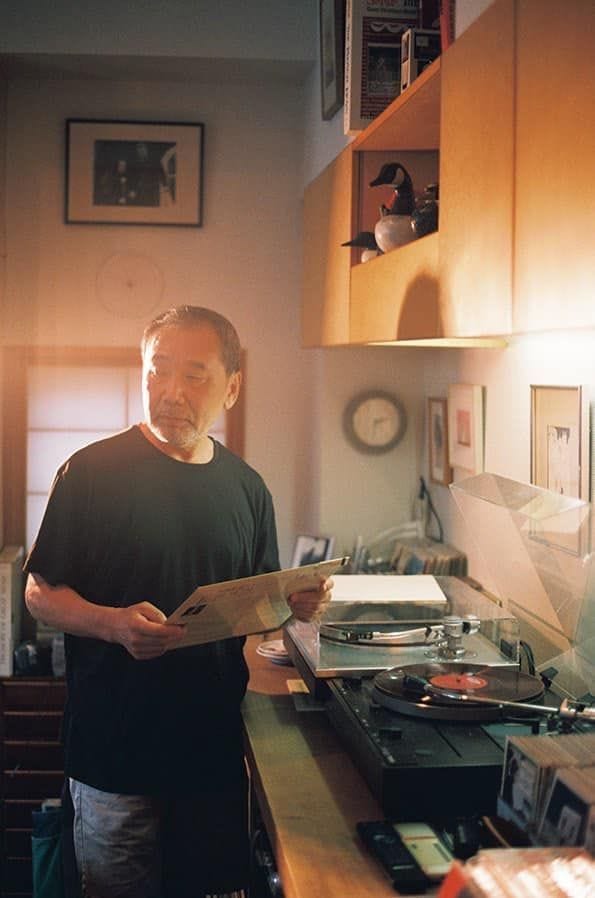
Nothing you take the time to learn is ever wasted; there’s always a use for it later, usually somewhere you didn’t expect — like rhythm in sports, or mindfulness in taste.
Exploration is both unglamorous and insanely fun.
It’s unglamorous because it’s like trying to walk through unknown lands without a map and you’re trying to make said map as you go and it’s hard and it can be boring but it’s insanely fun because you’re traveling through a wonderland of your every interest guided only by the trails of curiosity and wonder.
Find what the sound of one hand clapping is. Go deep. Ask for a reading list. Look into “self-education 2026 guides” — most of them are slop so I recommend just searching for long form content throughout Youtube (there are so many Yale and Harvard courses and experts who give out their knowledge for free) and Substack and whatever tickles your fancy.
Read the guides people write for exactly this.
And stay consistent. This isn’t an overnight process. This isn’t a “30 days to develop taste.” It’s a continuous way of life, a philosophy of constant search and curiosity and improvement if you will.


III. Do what you can’t
Then you get your hands dirty.
This is the step that’s easiest to skip because consuming is comfortable and producing can be humiliating.
But attempting and literally just doing things gives you something no amount of learning can — and I don’t mean just the literal skill you’re developing, like writing or painting.
Literally just doing things gives you confidence.
Doing things slowly accumulates evidence that you are a person who can figure shit out, which changes the threshold for the next thing you’re willing to attempt.
This part, like with most periods of improvement, only makes sense in retrospect.
I read my old articles and I can see the distance.
I had the irrational confidence to just do things without any proof that it would work or that I was good — that irrationality led to action, which led to improvement, the current articles, which led to confidence, i.e. I’m someone who can figure shit out and I’m relatively skilled at what I do.
And I’m not telling you that you have to start some personal business or create content. I’m encouraging you to just do things.
You can just pick up a chisel and chip away at stone without knowing what you’re doing.
You can literally just start cooking.
You can literally just start writing a memo.
You can literally just travel to any country and soak yourself in its culture.
You can literally just sign up for ballet.
You can literally just start playing guitar.
The audacity to try will develop skill, which will develop taste, which will improve quality of life.
Agency is self-creation.
That’s all “taste” is.
It’s lowkey just fancy polymathy, but I digress.
Clear all the shit. Fill it with real things. Try to make some yourself. Look back in a year.
And don’t be in a hurry, because taste is not a video game you finish. There is no finished version of who you are and what you like.
There’s no summit.
Just another peak, and another one behind it.
That’s the fun of it don’t you think?
Nothing more. Nothing less.
~ Alexander
Follow me on X for more posts on philosophy, personal development, and curating a meaningful existence.
Weekly articles Tuesday, Thursday & Sunday 10:00am PST.
When you’re ready:
Subscribe to Alexander Romance — full archive, 3 articles a week, free
Read the founding essays:


The first article that I have read from you in a while man—and you still have not lost that ability to create fuckin fantastic thumbnails.
Loved it, but don't you think there is a danger that we can simply replace one form of conditioning with a more sophisticated one?
Like for example, someone can move from TikTok to Tarkovsky films. Now that is a superb transition and better use of one's time, but it is STILL (unless they are aspiring to become a director) not necessarily becoming any more conscious of why they prefer what they prefer...
Sooo, I should start my solo game dev project even tho I’m not all skilled but can figure it out…a candid take home